
A Deep Dive into the MCP Specification
Explore the latest Model Context Protocol (MCP) specification, from architecture and JSON-RPC messaging to tools, resources, prompts, authorization, security, transports, and extensibility—everything developers need to build scalable, interoperable AI integrations.
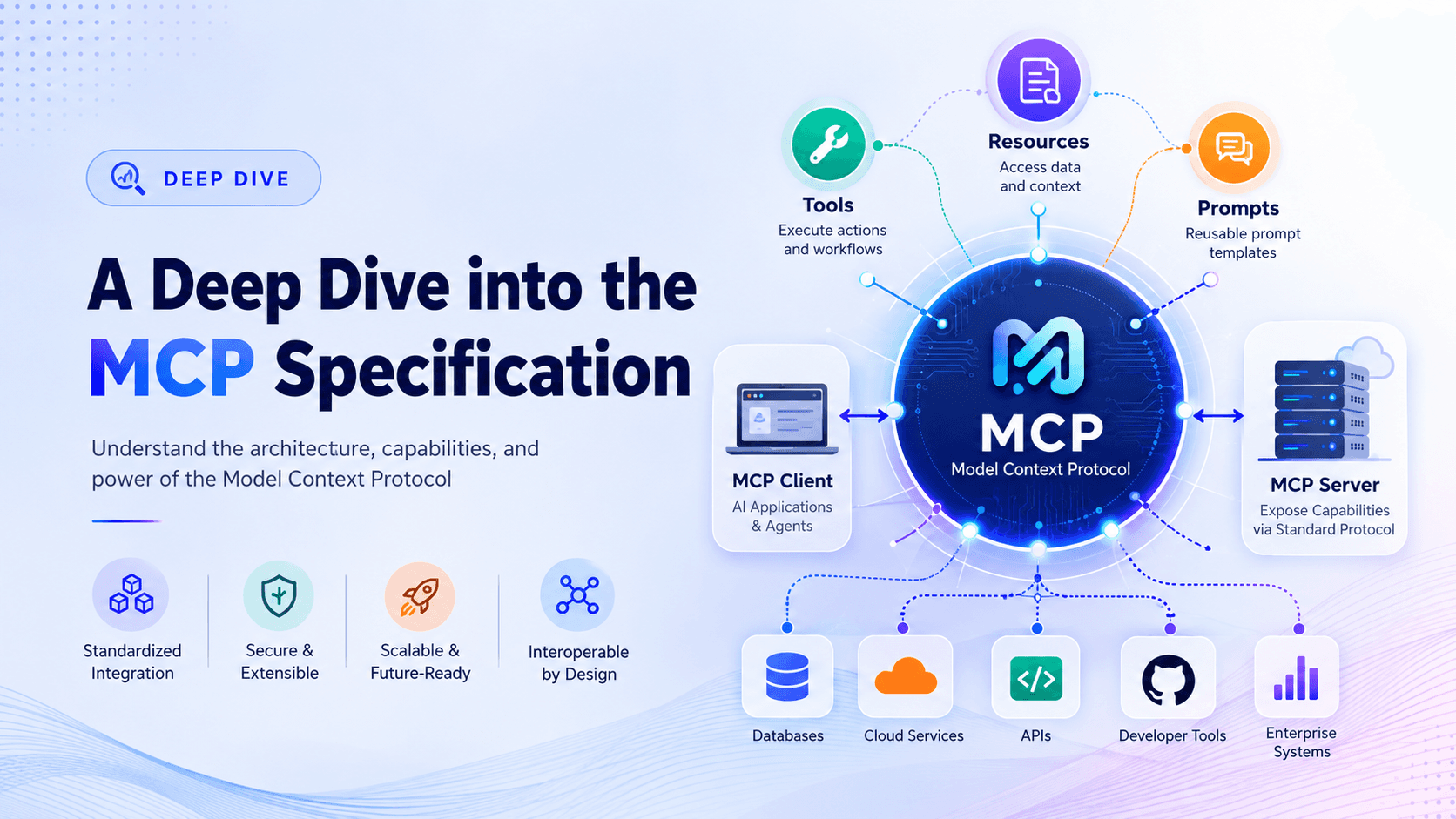
A Deep Dive into the Model Context Protocol
The Model Context Protocol (MCP) is an open standard designed to provide a consistent way for AI applications to connect with external tools, data sources, services, and workflows.
Instead of every AI application implementing proprietary integrations for every external system, MCP establishes a common protocol through which AI applications and external capabilities can communicate.
At its core, MCP defines communication between three primary components:
- Host — The AI application or environment coordinating the overall experience.
- Client — The protocol component within the host that communicates with an MCP server.
- Server — A service exposing capabilities and contextual information through MCP.
MCP uses JSON-RPC 2.0 as its underlying message format, providing a structured and implementation-independent mechanism for exchanging requests, responses, notifications, and errors.
Understanding the MCP Architecture
An MCP-powered system can be viewed conceptually as:
AI Application / Host → MCP Client → MCP Server → Tools, Resources & External Systems
A host may communicate with multiple MCP servers, allowing an AI application to combine capabilities from databases, APIs, developer tools, enterprise platforms, cloud services, internal systems, and other data sources.
This separation creates an ecosystem where MCP servers can expose capabilities independently while compatible AI clients can discover and consume them through a standardized protocol.
Core MCP Capabilities
Tools
Tools expose executable functions that an AI model can invoke.
Examples include:
- Searching an external system
- Querying a database
- Creating or updating records
- Calling an enterprise API
- Running calculations
- Triggering automation workflows
A server describes each tool using a name, description, input schema, and associated metadata so that clients and AI models can understand how the capability should be used.
Resources
Resources provide contextual information or data that an application or AI model can consume.
Resources may represent documents, configuration files, database records, API responses, source code, application state, or virtually any other contextual information exposed by an MCP server.
Prompts
Prompts allow servers to expose reusable, parameterized prompt templates and workflows.
Rather than embedding every workflow directly inside an AI application, servers can publish prompts that clients discover and invoke dynamically.
This makes prompts reusable capabilities within the MCP ecosystem.
The Protocol Layer
MCP defines standardized protocol operations for discovering and interacting with capabilities.
Typical interactions include operations such as:
tools/list
Discover the tools exposed by a server.
tools/call
Execute a selected tool with structured arguments.
resources/list
Discover available resources.
resources/read
Retrieve the contents of a resource.
prompts/list
Discover reusable prompts.
prompts/get
Retrieve a prompt using the supplied arguments.
Because these interactions follow standardized message structures, MCP clients can communicate with independently developed MCP servers without requiring application-specific integration logic for every server.
A Stateless Protocol Core
One of the most significant developments in the latest MCP specification is the move toward a stateless protocol core.
Requests are designed to be self-contained rather than depending on a persistent protocol session. Important information—including protocol version, client identity, and applicable capabilities—can accompany individual requests.
This architecture makes remote MCP infrastructure considerably easier to scale.
Requests can be processed across server instances behind conventional load balancers without requiring the same instance to maintain a protocol session for every client.
For developers building production MCP infrastructure, this improves scalability, reliability, routing, and deployment flexibility.
Capability Discovery
Clients need a way to understand what an MCP server supports.
The modern protocol supports capability information on requests as well as explicit server discovery when a client wants to understand server capabilities before performing another operation.
This allows clients and servers to negotiate functionality while remaining extensible as MCP evolves.
A client can therefore adapt its behaviour based on what a particular server actually supports rather than assuming that every MCP implementation provides the same features.
HTTP-Native Routing
Modern MCP also improves how requests can be handled by gateways, proxies, and enterprise infrastructure.
Information such as the MCP method and capability name can be represented through HTTP headers, enabling infrastructure to make routing, authorization, observability, or policy decisions without having to deeply inspect every JSON-RPC payload.
This makes MCP considerably more compatible with production API gateways and cloud-native architectures.
Authorization and Security
Security is fundamental to MCP because servers may expose sensitive data or capabilities capable of performing real-world actions.
A production implementation should consider:
- Authentication and authorization
- User consent
- Least-privilege access
- Secure credential handling
- Data privacy
- Tool execution approval
- Input validation
- Server trust
- Auditability
- Protection against malicious or untrusted tool metadata
MCP authorization builds upon established web security standards and continues to evolve toward stronger OAuth and OpenID Connect-compatible deployment patterns.
Importantly, protocol compatibility alone does not make an MCP server trustworthy. Clients and hosts must still enforce appropriate security, consent, and access-control policies.
Elicitation
MCP communication is not limited to an AI model simply calling server tools.
Elicitation allows an MCP server to request additional information when it cannot complete an operation with the information already available.
For example, a server processing a booking workflow might require the user to select an option or provide additional structured information before the workflow can continue.
This enables richer human-in-the-loop AI experiences.
Extensions
MCP now provides a formal extension model for functionality that does not need to belong permanently to the core protocol.
Extensions allow the ecosystem to evolve while keeping the underlying protocol focused and interoperable.
Examples include capabilities for:
- Long-running asynchronous tasks
- Interactive MCP applications and user interfaces
- Structured agent skills and workflows
- Enterprise authorization scenarios
This architecture allows specialized capabilities to evolve independently while remaining compatible with the broader MCP ecosystem.
Why MCP Matters
The real value of MCP is interoperability.
Without a common protocol, an AI application may require separate integration logic for GitHub, databases, cloud platforms, internal APIs, file systems, developer tools, business applications, and hundreds of other services.
MCP introduces a common integration boundary:
Build the capability once as an MCP server → Connect it to compatible MCP clients and AI applications.
This separation reduces integration complexity and encourages a reusable ecosystem of AI-accessible capabilities.
Building Production-Ready MCP Systems
Understanding the specification is only the beginning.
Production implementations must also address:
Protocol compliance — Are requests, responses, errors, schemas, and capabilities implemented correctly?
Security — Are authentication, authorization, consent, credentials, and sensitive data handled safely?
Reliability — How does the system behave during failures, cancellations, timeouts, and malformed requests?
Compatibility — Does the implementation behave consistently across different MCP clients and servers?
Observability — Can developers inspect requests, responses, latency, errors, and capability interactions?
Scalability — Can remote MCP servers operate efficiently across distributed infrastructure?
These concerns become increasingly important as MCP moves from experimental integrations into production AI and agentic systems.
The Future of AI Integration
MCP is evolving beyond a simple mechanism for connecting language models to tools.
Its emerging architecture provides foundations for scalable AI integrations, agentic workflows, interactive applications, asynchronous operations, enterprise authorization, and richer communication between AI systems and external services.
For developers, understanding MCP at the protocol level provides a significant advantage: it makes it possible not only to use MCP, but also to design, test, secure, troubleshoot, and validate MCP systems correctly.
As AI applications become increasingly connected to real-world systems, standards such as MCP can provide the interoperability layer that allows those integrations to remain portable, extensible, and manageable.
Specification covered: MCP 2026-07-28
Key topics: Architecture · JSON-RPC 2.0 · Clients · Servers · Tools · Resources · Prompts · Discovery · Transports · Authorization · Elicitation · Extensions · Security · Scalability
More from the blog
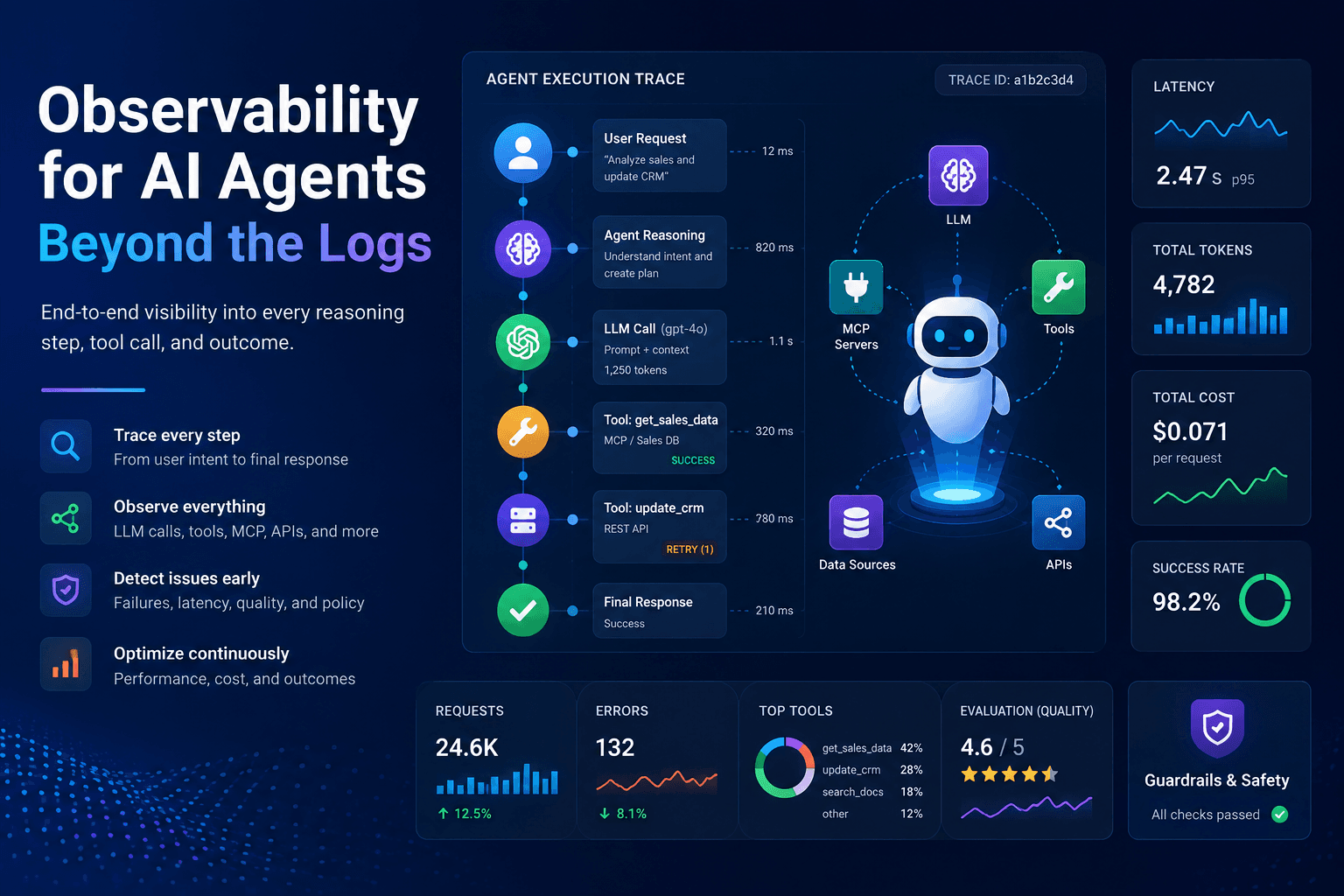
Observability for AI Agents - Beyond the Logs
Go beyond traditional logs with modern AI agent observability. Trace LLM interactions, tool and MCP calls, latency, token usage, costs, failures, and outcomes to understand agent behavior, accelerate debugging, and build reliable production-ready AI systems.
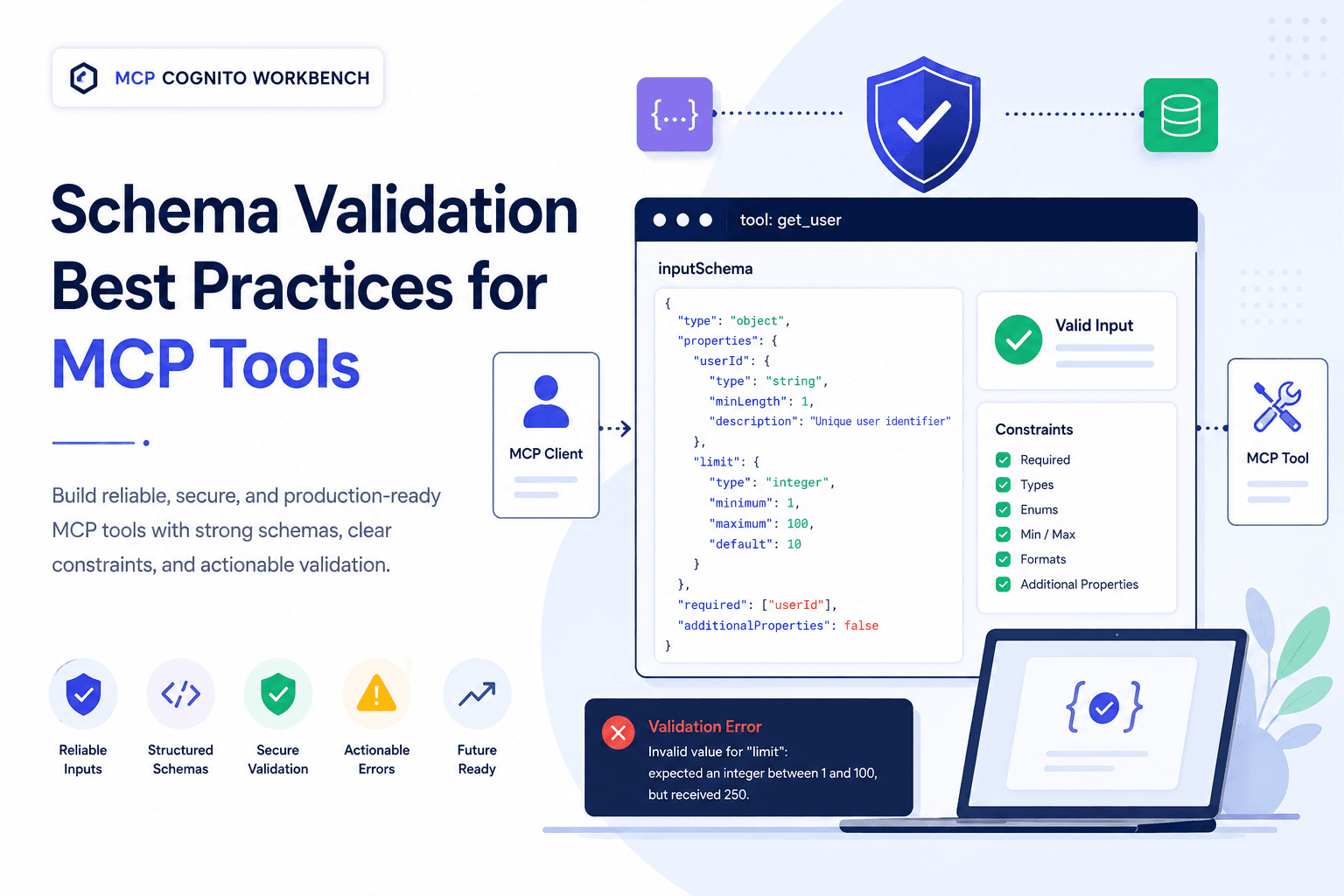
Schema Validation Best Practices for MCP Tools
Build reliable, secure, and production-ready MCP tools with robust schema validation. Explore best practices for input constraints, structured outputs, actionable errors, security, compatibility, and testing to create predictable, interoperable MCP integrations.
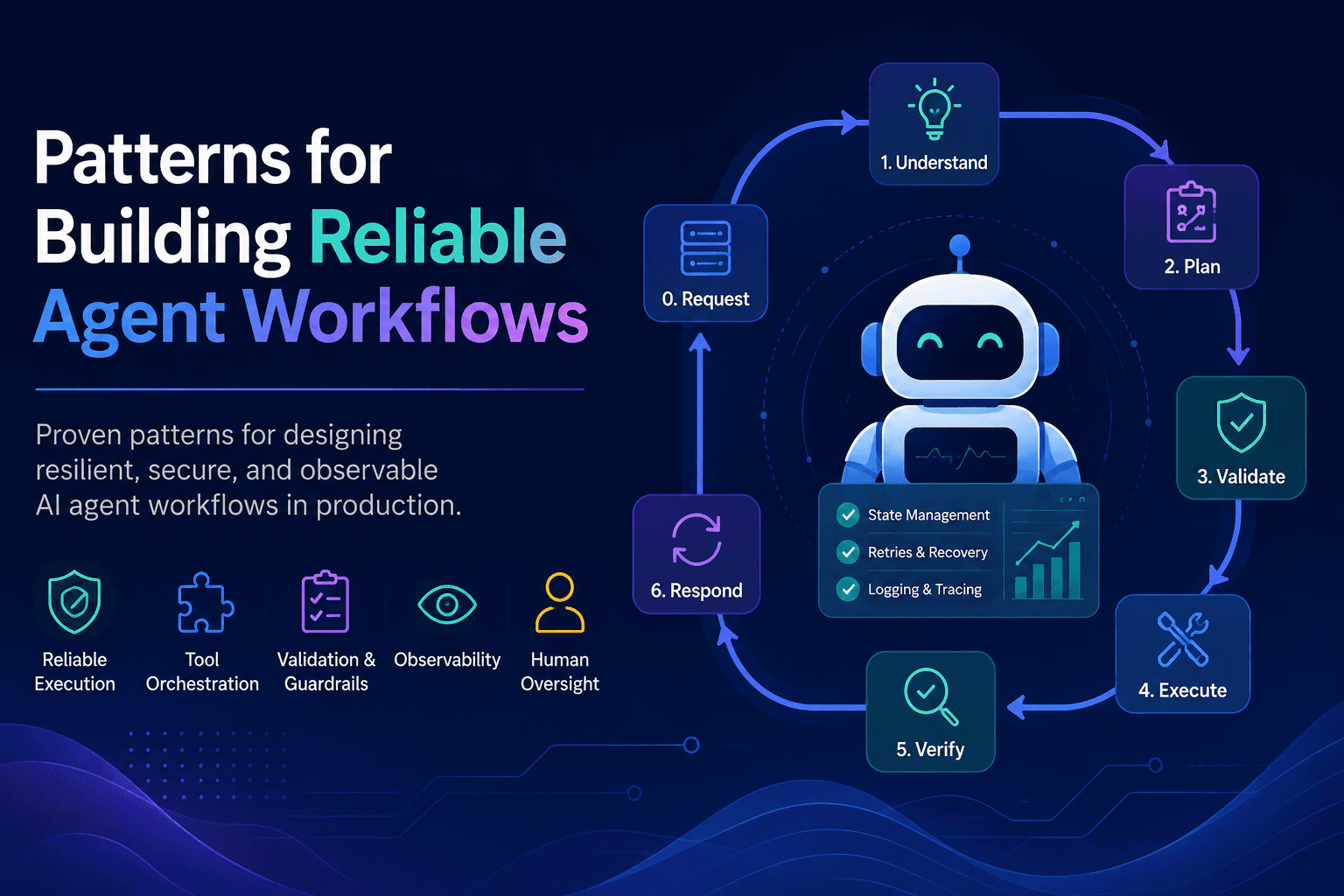
Patterns for Building Reliable Agent Workflows
Discover proven patterns for building reliable AI agent workflows with structured planning, safe tool use, validation, retries, observability, state management, and human oversight—designed for resilient, production-ready agent systems.